Showing posts with label #abacus #abacist #benefit #training #calculetor #calculation #mathematics #brain #develops #understnding #logical #improved #visualisation. Show all posts

Thursday, 2 August 2018

Mental Math Help Abacus Work


 Mental Math Help Abacus Work

Most of young children started to learn "numbers" by counting their fingers. It is difficult for them to comprehend numeric relationships beyond the number 10 for lack of countable
objects. Using regular math, children can use nothing but limited memory and brain power to solve arithmetic problems. Abacus presents multi-digit numeric relationships in a concrete bead-based system. Using an abacus, young children can relate number values and comprehend the concepts of mathematics easily. Therefore, the abacus math is far more superior to regular math that is presented to children in an abstract form.

Abacus math establishes numeric relations in a clear and logical way for small children. The abacus mental picture training will elevate memory power and improve concentration of a child. The speed training enables the child to respond to questions promptly. In addition, the speed hearing training encourages the child to dedicate full attention to study by listening more attentively and effectively. Ultimately, the abacus training will make the learner more confident and interested in school works, both curricular and extra-curricular. His/Her creativity and ability to analyze problems will be improved considerably.

Arithmetic skill can be trained in different ways. However, resolving a mathematical problem quickly and accurately is not always accomplished by every child. The abacus math program complements and supplements the arithmetic approaches adopted in schools, and helps students to overcome the fears of mathematics, if any, and gain confidence. Evidence shows that those who have taken the abacus math program would have the following advantages :

Improved comprehension in math Better and faster calculation skills
Better problem solving skills
Clearer logic reasoning
More attentive to instructions
Keener listening skill
Sharper memory
Better reflexes
Stronger mental formation skills
Improved confidence and self-esteem
Better endurance of stress and pressure
Better and faster calculation skills

Outcome of the abacus math program will also influence and be transferred to other subjects.

For more details please Contact Us....... Perfect Academy....... 08820998099.

Tuesday, 26 June 2018

Abacus Training for Teachers


 Abacus Training for Teachers

Abacus we have been training professionals and teachers and aspiring candidates on our Abacus Online - Teacher Training Program and have been very successful in doing that for years now.You can easily approach us and find this possibility of getting trained on Abacus online and becoming an Abacus trainer at the comforts of your own space and time. Our one-to-onefocus system of Abacus training via the internet makes it very easy for everyone on a computer for learning Abacus and qualifies as Abacus Teacher online. You are provided with all the tools and learner kit beforehand to start learning Abacus online.

Abacus or let's saymaster-shipto solve arithmetic operation mentally, it one and the same.Mind Math has been always had been a need to times when I was young so was with generations earlier to me and generations grooming ahead of my time. No technical advancement can replace a need to inculcate mentalabilitiesin us, be it any smartphone or a supercomputer at all times. A need for such skill sets to be mastered will always be the first choice of growing years in our lives.But yes, we can usetechnologyas a device or tool to meet our objective to serve our cause to end user.Abacus Online Learning Made Easy!


Abacus Online Training for Distant Teachers is an option for seriously willing ventures to reach up to us to learn Abacus online. We make it so easy for you with best of the results for you in the business as an answer to your most sought after question, How to learn Abacus.

Effective Abacus learning online is now easy and affordable teacher training via online video meeting. You can be in any country, city or remotest town on earth, Now you can have access to best of the training via video meetings to learn methods and techniques of learning Abacus to train children around you.

You need to have a computer or laptop with access internet with camera, mic and speakers to start learning Abacus online. These training sessions can be on your preferred time and dates. You may be a working professional or not freedom of learning at an own pace and at own terms is easy.


Globally, we have come across many willing to learn Abacus to make children do mind math and scaling up children's brain for effective brain functions for outstanding personalities in life.

Unavailability of efficient and legitimate learning facilities either creates a probability for those to use misdirected learning resources online and in public domain in general or follow unprofessional sources with no methodology, scientific approach and delivery plan.

Our Abacus teacher training offer brings options for everyone to learn it.

Learning Abacus online via skype makes it easier for you to learn Abacus at your own pace. We offer Abacus classes online to students. We offer Abacus online training to teachers. At 1Abacus we make Abacus online learning a fun and interesting way to learn mind math skills both for students and trainers. 


Our Abacus online classes methods make it is simple for learning Abacus for addition, subtraction, multiplication, division, fractions, square root, cube root, LCM/HCF and addition subtraction resulting in -ve answers. Every topic and its concept covered in our online sessions. Our experts with more than 16 year of Abacus teaching will teach you bit by bit on every bit of Abacus.

We guarantee nothing but best of Abacus online learning experience for you. Using your computer or laptop to evolve as a favourite for parents and students is your choice with technology. The World with skype, facebook, twitter etc. etc. is using these resource to enhance its skill set by learning, teaching and Earning. Any country, city or semi test of the place you live in, Checkout with us with this option of learning Abacus with after course support.

For more details please Contact Us....... Perfect Academy....... 08820998099.

Thursday, 7 June 2018

Math Help The School Work


Math Help The School Work

Most of young children started to learn "numbers" by counting their fingers. It is difficult for them to comprehend numeric relationships beyond the number 10 for lack of countable
objects. Using regular math, children can use nothing but limited memory and brain power to solve arithmetic problems. Abacus presents multi-digit numeric relationships in a concrete bead-based system. Using an abacus, young children can relate number values and comprehend the concepts of mathematics easily. Therefore, the abacus math is far more superior to regular math that is presented to children in an abstract form.

Abacus math establishes numeric relations in a clear and logical way for small children. The abacus mental picture training will elevate memory power and improve concentration of a child. The speed training enables the child to respond to questions promptly. In addition, the speed hearing training encourages the child to dedicate full attention to study by listening more attentively and effectively. Ultimately, the abacus training will make the learner more confident and interested in school works, both curricular and extra-curricular. His/Her creativity and ability to analyze problems will be improved considerably.

Arithmetic skill can be trained in different ways. However, resolving a mathematical problem quickly and accurately is not always accomplished by every child. The abacus math program complements and supplements the arithmetic approaches adopted in schools, and helps students to overcome the fears of mathematics, if any, and gain confidence. Evidence shows that those who have taken the abacus math program would have the following advantages :

Improved comprehension in math Better and faster calculation skills
Better problem solving skills
Clearer logic reasoning
More attentive to instructions
Keener listening skill
Sharper memory
Better reflexes
Stronger mental formation skills
Improved confidence and self-esteem
Better endurance of stress and pressure
Better and faster calculation skills

Outcome of the abacus math program will also influence and be transferred to other subjects.

For more details please Contact Us....... Perfect Academy....... 08820998099.


Thursday, 24 May 2018

Introduction of Abacus


 Introduction of Abacus

The abacus is a mechanical aid used for counting; it is not a calculator in the sense we use the word today.


Anatomy & Construction :
The standard abacus can be used to perform addition, subtraction, division and multiplication; the abacus can also be used to extract square-roots and cubic roots. The beads are manipulated with either the index finger or the thumb of one hand.

The abacus is typically constructed of various types of hardwoods and comes in varying sizes. The frame of the abacus has a series of vertical rods on which a number of wooden beads are allowed to slide freely. A horizontal beam separates the frame into two sections, known as the upper deck and the lower deck.


ABACUS PARTS :
The various parts of the abacus are identified here: the frame, the beam, the beads and rods and the upper and lower decks.


Preparation & Bead Values :

PREPARING THE ABACUS:
 The abacus is prepared for use by placing it flat on a table and pushing all the beads on both the upper and lower decks away from the beam by sliding the thumb along the beam.


BEAD VALUES
Each bead in the upper deck has a value of 5; each bead in the lower deck has a value of 1.
Beads are considered counted, when moved towards the Beam— the piece of the abacus frame that separates the two decks.

Counting :
After 5 beads are counted in the lower deck, the result is "carried" to the upper deck; after both beads in the upper deck are counted, the result is then carried to the left-most adjacent column.

The right-most column is the ones column; the next adjacent to the left is the tens column; the next adjacent to the left is the hundreds column, and so on. Floating point calculations are performed by designating a space between 2 columns as the decimal-point and all the rows to the right of that space represent fractional portions while all the rows to the left represent whole number digits.


Abacus Applet:
 Numeric representation of the number: 87,654,321. If your browser is Java-capable then the applet, above, will identify the parts of the abacus in your browser's status-area as you move your mouse-pointer over it; the beads will move when you click on them and the value of each column will be displayed on the top frame.
Referring to the Figure/Applet above, the third column, representing the number 8, is counted with 1 bead from the top-deck and 3 beads from the bottom-deck ; the sum of the column is 8.

Similarly, the fourth column representing the number 7, is counted with 1 bead from the top-deck and 2 beads from the bottom-deck; the sum of the column is 7.

Technique :
Proper finger technique is paramount in achieving proficiency on the abacus. With a Chinese abacus, the thumb and the index finger together with the middle finger are used to manipulate the beads. Beads in lower deck are moved up with the thumb and down with the index finger. In certain calculations, the middle finger is used to move beads in the upper deck.

The Java version of the abacus is a limited simulation of the real device because the fingering technique is completely obfuscated by the mouse. Abacus Apps on touch-screen tablets are better simulations. With a real abacus, constant practice is indispensable in achieving virtuosity in calculating speed.


Finger Technique:
 A Japanese textbook published in 1954 shows the proper technique for moving the beads. It shows the thumb being used to count beads in the lower deck and the index finger being used in all other cases.
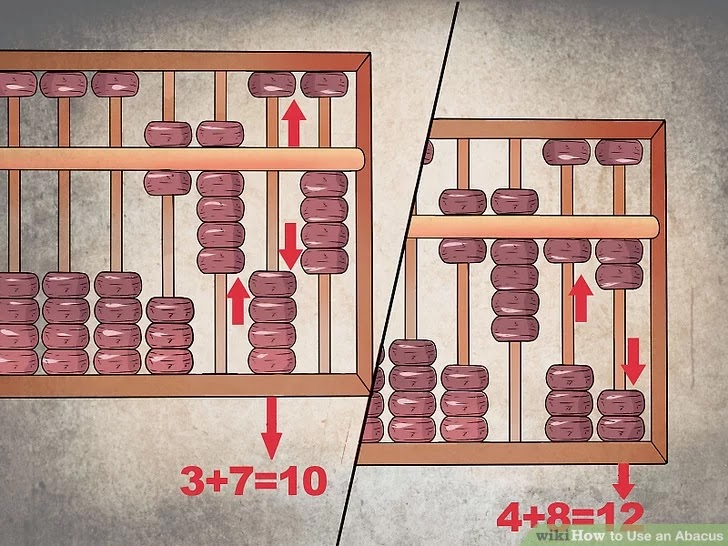
With the Japanese version, only the index finger and thumb are used. The beads are moved up with the thumb and down with the index finger. However, certain complex operations require that the index finger move beads up; e.g. adding 3 to 8.


For more details please Contact Us....... Perfect Academy....... 08820998099.

Friday, 13 April 2018

Learning Abacus Teacher Training Skills


Learning Abacus Teacher Training Skills

Learning Abacus is for those who are compassionate towards student, passionate about education, persistent till each student is knowledge equipped, up for challenges in training, result oriented in classroom, creative as well curious teacher, optimistic about each child's potential, flexible as well joyful and last but not the least one with love for and liking to be with children.

Learning Abacus includes all level training starting from skills of addition, subtraction to multiplication, division to percentages, decimal accurate multiplication, decimal accurate division, square root and cube root. Learning Abacus covers each corner of training i.e. operating Abacus, scaling the skill of manoeuvring beads, imaging/visualisation of Abacus with speed and accuracy making you result delivering trainer.

Learning Abacus qualifies you to be an Abacus teacher to train students for mental arithmetic with speed and accuracy.


Learning Abacus & Business Know-How:

Starting Abacus business with insufficient exposure can be fatal for your goodwill, time and money. Aligning with us on our extensive experience in the business offers your business an advantage for your customers with a sharp edge for you over your competitors by minimising risk.

We are experts in this business with our Abacus acumen of more than 12years now. Our knowledge resource is at your access, setting up a classroom, creating a promotional campaign, business strategies, targeting parent, parent student satisfaction and a creation of word of mouth for you.

Getting exposed to our knowledge base before starting up widens the possibilities launch success. We induct you on methods and procedures customised to your business demography. Be it branding, promotion, marketing, presentation, counselling, retention or business alignment, our all time existence as your know-how expert is nothing but assured success.


Learning Abacus with Business Support Services:
Incepting Abacus business calls for varied backend activities before and after startup. This may range from targeted content development, self-branded books, tools manufacturing, creatives for campaigns, presentation tools, print jobs and individualistic enhancement.


You have an access to utilise our best infrastructure and manpower for:
our resource o f content, for school training and private classroom based training which is developed after extensive experience and research and is always upgrading at intervals.
our in-house publishing facility, to have your own branded books to add value to your business and differentiation from other. Ease of expense as you may order fewer or bulk quantity lowers as per need. our varied range of manufactured abacus tools, from economy to premium range allow you to be just priced for a different audience of your services. our in-house creative team, for all your flyers, pamphlets, course brochures, power point presentations, templates etc. designs and custom made designs. our soft-skills training facility, it is helpful in upgrading your individual skill set for enabling you to be confident explaining what you do and how you do it and prepare you as your business spokesperson.

For more details please Contact Us....... Perfect Academy....... 08820998099.

Thursday, 29 March 2018

History of the Abacus


History of the Abacus

In this lesson, you will learn the definition of an abacus. You will review the history of the abacus and learn about the oldest abacus known to man. You will also learn about different types, such as the Chinese, Japanese and Russian abacuses, as well as some modern-day uses of the abacus.


What Is an Abacus? ---
The word abacus is derived from the Latin word abax, which means a flat surface, board or tablet. As such, an abacus is a calculating table or tablet.

The abacus is the oldest device in history to be used for arithmetic purposes, such as counting. It is typically an open wooden rectangular shape with wooden beads on vertical rods. Each bead can represent a different number. For simple arithmetic purposes, each bead can represent one number. So, as a person moves beads from one side to the other, they would count, 'one, two, three', etc.

An abacus can be used to calculate large numbers, as well. The columns of beads could represent different place values. For example, one column may represent numbers in the hundreds, while another column may represent numbers in the thousands.


History of the Abacus ---
The written numbers did not exist many, many years ago. But individuals still needed a way to count, especially merchants selling fruits, vegetables and other goods. This is how the abacus came of use. It has been said that the first abacuses were just flat boards. Rocks would be placed on the board and moved about for calculation purposes. Other abacuses had a film of sand or dust on the top of the surface and one would use their finger to make calculations.

Using rocks, seashells and fingers on the abacus could only be helpful to a certain extent. That is when the wooden beads became helpful.

The oldest abacus known to man is the Salamis Tablet, named for the island of which it was found--Salamis Island in Greece--the nearest island to the capital of Athens. It was found in 1846 and can be dated back to 300 BCE. The Roman hand abacus was the next abacus to be discovered. It was used in 300 CE in business, engineering and architecture. This is when the Romans were using Roman numerals. The abacus has come a long way since being used in ancient times by the Greeks and Romans.


Chinese, Russian and Japanese Abacuses ---
One of the most popular kinds of abacuses is the Chinese abacus, also known as the suanpan. Rules on how to use the suanpan have dated all the way back to the 13th century.

On a Chinese abacus, the rod or column to the far right is in the ones place. The one to the left of that is in the tens place, then the hundreds, etc. So, the columns are different place values and the beads are used to represent different numbers within those place values. For addition, beads on the suanpan are moved up towards the beam in the middle. For subtraction, they are moved down towards the bottom or outer edge of the suanpan. The rules of use are a bit more intricate and complicated, but this is the general idea of how one is used.

The Japanese abacus is called a soroban. Like the suanpan, the soroban is divided into two levels. The modern-day soroban has only one bead on the upper level and four beads on the lower level. For both the suanpan and the soroban, the top beads represent heaven, while the bottom beads represent Earth.

For more details please Contact Us....... Perfect Academy....... 08820998099.

Tuesday, 27 March 2018

A Brief Introduction to the Abacus


A Brief Introduction to the Abacus

The abacus is a mechanical aid used for counting; it is not a calculator in the sense we use the word today.


Anatomy & Construction :
The standard abacus can be used to perform addition, subtraction, division and multiplication; the abacus can also be used to extract square-roots and cubic roots. The beads are manipulated with either the index finger or the thumb of one hand.

The abacus is typically constructed of various types of hardwoods and comes in varying sizes. The frame of the abacus has a series of vertical rods on which a number of wooden beads are allowed to slide freely. A horizontal beam separates the frame into two sections, known as the upper deck and the lower deck.


ABACUS PARTS :
The various parts of the abacus are identified here: the frame, the beam, the beads and rods and the upper and lower decks.


Preparation & Bead Values :

PREPARING THE ABACUS:
 The abacus is prepared for use by placing it flat on a table and pushing all the beads on both the upper and lower decks away from the beam by sliding the thumb along the beam.


BEAD VALUES
Each bead in the upper deck has a value of 5; each bead in the lower deck has a value of 1.
Beads are considered counted, when moved towards the Beam— the piece of the abacus frame that separates the two decks.

Counting :
After 5 beads are counted in the lower deck, the result is "carried" to the upper deck; after both beads in the upper deck are counted, the result is then carried to the left-most adjacent column.

The right-most column is the ones column; the next adjacent to the left is the tens column; the next adjacent to the left is the hundreds column, and so on. Floating point calculations are performed by designating a space between 2 columns as the decimal-point and all the rows to the right of that space represent fractional portions while all the rows to the left represent whole number digits.


Abacus Applet:
 Numeric representation of the number: 87,654,321. If your browser is Java-capable then the applet, above, will identify the parts of the abacus in your browser's status-area as you move your mouse-pointer over it; the beads will move when you click on them and the value of each column will be displayed on the top frame.
Referring to the Figure/Applet above, the third column, representing the number 8, is counted with 1 bead from the top-deck and 3 beads from the bottom-deck ; the sum of the column is 8.

Similarly, the fourth column representing the number 7, is counted with 1 bead from the top-deck and 2 beads from the bottom-deck; the sum of the column is 7.

Technique :
Proper finger technique is paramount in achieving proficiency on the abacus. With a Chinese abacus, the thumb and the index finger together with the middle finger are used to manipulate the beads. Beads in lower deck are moved up with the thumb and down with the index finger. In certain calculations, the middle finger is used to move beads in the upper deck.

The Java version of the abacus is a limited simulation of the real device because the fingering technique is completely obfuscated by the mouse. Abacus Apps on touch-screen tablets are better simulations. With a real abacus, constant practice is indispensable in achieving virtuosity in calculating speed.


Finger Technique:
 A Japanese textbook published in 1954 shows the proper technique for moving the beads. It shows the thumb being used to count beads in the lower deck and the index finger being used in all other cases.
With the Japanese version, only the index finger and thumb are used. The beads are moved up with the thumb and down with the index finger. However, certain complex operations require that the index finger move beads up; e.g. adding 3 to 8.

For more details please Contact Us....... Perfect Academy....... 08820998099.

Monday, 12 March 2018

Abacus Teaching System


Abacus Teaching System

The #abacus is a deceptively simple #calculating tool still used all over the world. It's a useful learning device for the visually impaired, as well as for anyone who wants to learn the roots of the modern calculator. After learning the basics of counting on the abacus, you can quickly perform arithmetic like addition, subtraction, multiplication, and division.

#Counting


Orient your abacus properly --- Each column in the top row should have one or two beads per row, while each column in the bottom row should have four. When you start, all of the beads should be up in the top row, and down in the bottom row. The beads in the top row represent the number value 5 and each bead in the bottom row represents the number value 1.


 Assign each column a place value --- As on a modern calculator, each column of beads represents a "place" value from which you build a numeral. So, the farthest column on the right would be the "ones" place, the second farthest the "tens" place, the third farthest the hundreds, and so on. You can also assign some columns to be decimal places if necessary. For example, if you are representing a number like 10.5, then the furthest right column would be the tenths place, the second column would be the ones place, and the third column the tens place. Likewise, to represent a number like 10.25, the furthest right column would be the hundredths place, the second column would be the tenths place, the third the ones place, and the fourth the tens place.


Start counting with the beads in the lower row --- To count a digit, push one bead to the "up" position. "One" would be represented by pushing a single bead from the bottom row in the farthest column on the right to the "up" position, "two" by pushing two, etc. You'll find it easiest to use your thumb to move the beads in the top row, and your index finger to move the beads in the bottom row.


 Complete the "4/5 exchange.”--- Since there are only four beads on the bottom row, to go from "four" to "five," you push the bead on the top row to the "down" position and push all four beads from the bottom row down. The abacus at this position is correctly read "five." To count "six," push one bead from the bottom row up, so the bead in the top row is down and one bead from the bottom row is up.


 Repeat the pattern for higher numbers --- The process is essentially the same across the abacus. Go from "nine," in which all the beads in the ones place are pushed up and the bead in the top row is pushed down, to "ten," in which a single bead from the bottom row of the tens place is pushed up. For example, 11 would have one bead in the second column pushed up, and another in the first column pushed up, all on the bottom row. Twelve would have one in the second column and two in the first column, all pushed up, and all on the bottom row. Two hundred and twenty six would have two in the third column pushed up in the bottom row, and two in the second column pushed up in the bottom row. In the first column, one bead on the bottom row would be pushed up, and the bead on the top row would be pushed down.


#Adding and #Subtracting


 Input your first number --- Say you've got to add 1234 and 5678. Enter 1234 on the abacus by pushing up four beads in the ones place, three in the tens place, two in the hundreds place, and one in the thousands place.


Start adding from the left --- The first numbers you'll add are the 1 and the 5 from the thousands place, in this case moving the single bead from the top row of that column down to add the 5, and leaving the lower bead up for a total of 6. Likewise, to add 6 in the hundreds place, move the top bead in the hundreds place down and one bead from the bottom row up to get a total of 8.


 Complete an exchange --- Since adding the two numbers in the tens place will result in 10, you'll carry over a 1 to the hundred place, making it a 9 in that column. Next, put all the beads down in the tens place, leaving it zero. In the ones column, you'll do essentially the same thing. Eight plus 4 equals 12, so you'll carry the one over to the tens place, making it 1. This leaves you with 2 in the ones place.


 Count your beads to get the answer --- You're left with a 6 in the thousands column, a 9 in the hundreds, a 1 in the tens, and a 2 in the ones: 1,234 + 5,678 = 6,912.

#Multiplying


 Record the problem on the abacus --- Start at the farthest left column of the abacus. Say you're multiplying 34 and 12. You need to assign columns to "3", "4", "X", "1", "2", and "=". Leave the rest of the columns to the right open for your product. The “X” and “=” will be represented by blank columns. The abacus should have 3 beads up in the farthest column left, four up in the next farthest, a blank column, a column with one bead up, two beads up in the next, and another blank column. The rest of the columns are open.


 Multiply by alternating columns --- The order here is critical. You need to multiply the first column by the first column after the break, then the first column by the second column after the break. Next, you'll multiply the second column before the break by the first column after the break, then the second column before the break by the second column after the break. If you are multiplying larger numbers, keep the same pattern: start with the leftmost digits, and work to the right.


 Record the products in the correct order --- Start recording in the first answer column, after the blank one for the “=” sign. You will keep moving beads on the right hand portion of the abacus as you multiply the individual digits. For the problem 34 x 12: First, multiply 3 and 1, recording their product in the first answer column. Push three beads up in that seventh column. Next, multiply the 3 and the 2, recording their product in the eighth column. Push one bead from the upper section down, and one bead from the lower section up. When you multiply the 4 and the 1, add that product to the eighth column, the second of the answer columns. Since you're adding a 4 to a 6 in that column, carry one bead over to the first answer column, making a 4 in the seventh column and a 0 in the eighth. Record the product of the last two digits 4 and 2, in the last of the answer columns. They should now read 4, blank, and 8, making your answer 408.

#Dividing


 Leave space for your answer to the right of the divisor and the dividend --- When dividing on an abacus, you will put the divisor in the left-most column. Leave a couple blank columns to the right, then put the dividend in the columns next to those. The remaining columns to the right will be used to do the work leading to the answer. Leave those blank for now. For example, to divide 34 by 2, count 2 in the left-most column, leave two blank columns, then put 34 over to the right. Leave the other columns blank for the answer section. To do this, push two lower beads from the bottom portion up in the left-most column. Leave the next two columns alone. In the fourth column, push three beads from the bottom portion up. In the fifth column from the left, push four beads from the bottom portion up. The blank columns between the divisor and the dividend are just to visually separate the numbers so you don't lose track of what's what.

Record the quotient --- Divide the first number in the dividend by the divisor, and put it in the first blank column in the answer section. Two goes into 3 once, so record a 1 there. To do this, push one bead from the bottom portion up in the first column of the answer section. If you like, you can skip a column between the dividend and the columns you want to use for the answer section. This can help you distinguish between the dividend and the work you do as you calculate.


Determine the remainder --- Next, you need to multiply the quotient in the first answer section column by the dividend in column one to determine the remainder. This product needs to be subtracted from the first column of the dividend. The dividend should now read 14. To make the dividend read 14, push two of the bottom portion beads currently pushed up to the center bar at the fifth column back down to their starting position. Only one bead in the lower portion of the fifth column should remain pushed up to the center bar.

Repeat the process --- Record the next digit of the quotient in the next blank column of the answer section, subtracting the product from the dividend. Your board should now read 2, followed by blank columns, then 1, 7, showing your divisor and the quotient, 17. Two beads from the bottom portion of the left most column will be pushed up to the center bar. This will be followed by several blank columns. One bead from the bottom portion of the first answer section column will be pushed to the center bar.
In the next answer section column, two beads from the bottom portion will be pushed up to the center bar, and the bead from the top portion will be pushed down to it.